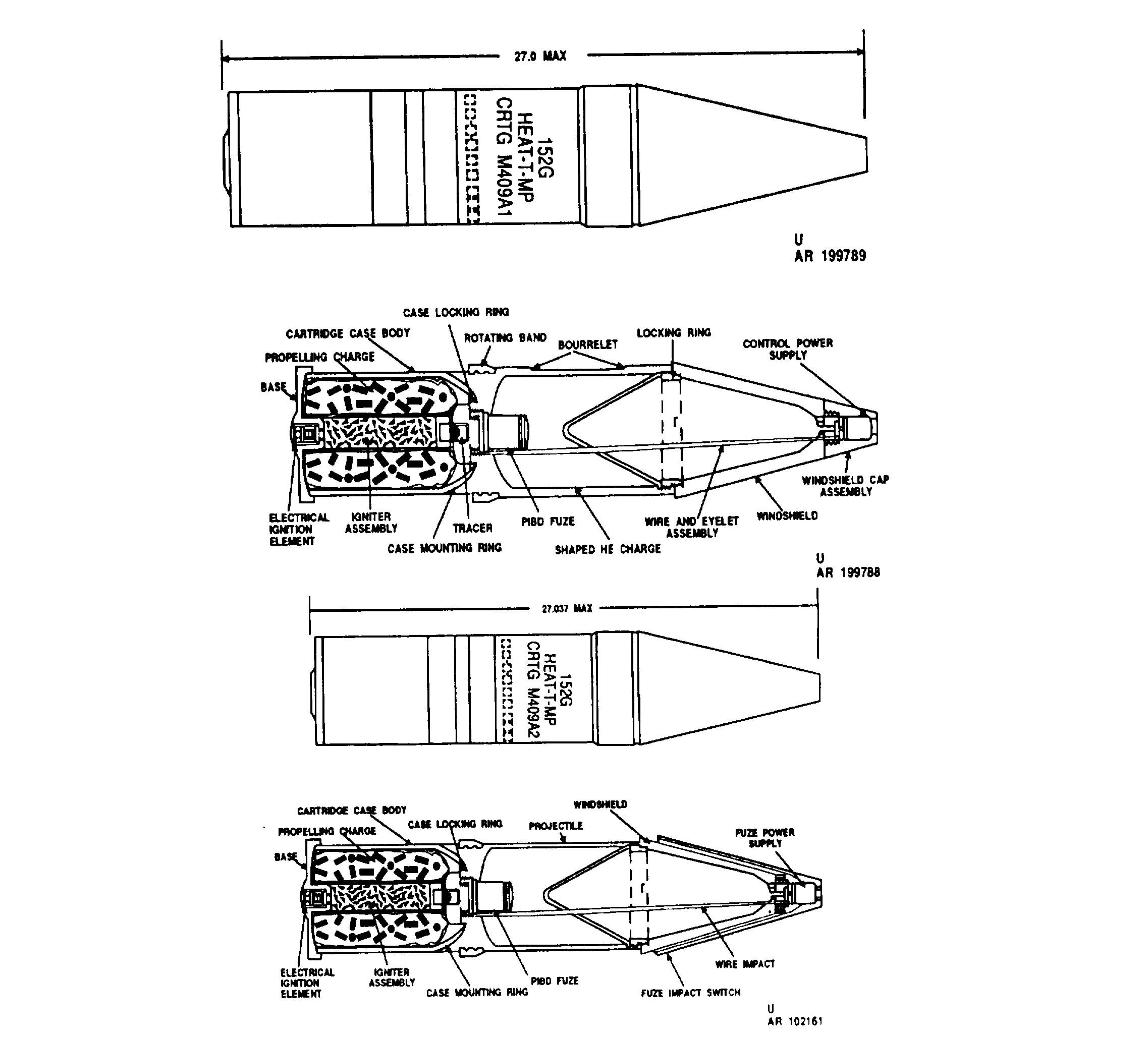
Description
This cartridge is fired from 152mm gun launchers primarily as an armor defeating round with additional antipersonnel capability.
The projectile consists of a forged steel body fitted with a steel windshield and a fluted copper cone liner to shape the high explosive charge. The liner is held in place by a steel locking ring. The windshield is threaded to the locking ring and houses an insulator and wire eyelet connector assembly. The wire connector assembly connects the fuze with the control power supply housed in a two-piece windshield cap. The control power supply provides the point-initiating, base-detonating fuze with electrical energy The projectile is loaded with Composition B, and the fuze is fitted in a cavity of the explosive charge. The tracer is contained in the base plug and is assembled to a steel fuze locking cup in the base of the projectile. A sintered iron rotating band, forward of the base, provides spin and obturation. Cartridge Case M205 used in M409A2 and M409A1 is a two piece assembly of base and body made of high density felted nitrocellulose, inert fibers, and resin. The body, containing a bagged propelling charge, is attached to the projectile by a steel mounting ring and aluminum case locking ring. The base houses the electric ignition system and is cemented to the body with a special nitrocellulose lacquer. Cartridge Case M157 used in Cartridge M409 is similar to the M205 in shape and function, but is of a different non-metallic flammable material. The M157 case is more vulnerable to fracture on impact than the M205, and the igniter primer is of a different design, The body is attached to the projectile by epoxy resin and a case locking ring.
The M409A2 model has the improved M509A1 PIBD fuze and has the full frontal area impact switch enabling the projectile to be effective on all areas of the ogive.
The projectile is black with yellow markings, or black with white markings and a yellow band.
Functioning
Electric current from the firing mechanism of the weapon initiates the ignition element/initiator. The resulting flash ignites the propellant, and the burning propellant generates gases to force the projectile from the gun tube and concurrently ignite the tracer. When the round is used against armor; electrical energy from the control power supply in the nose of the projectile is fed to the fuze on impact. Functioning of the fuze detonates the shaped explosive charge of Composition B to collapse the copper cone and create a high-velocity focused shock wave. The intensity of the shock wave causes failure of the target armor, and a jet of metal particles penetrates the interior of the target. For antipersonnel use, the round is fired so the fuze will function on graze or direct impact on target. Blast and fragmentation created by detonation of’ the explosive charge inflicts casualties.
Hazardous Components
Filler - Composition B (6.3 lb, 2.86 kg)
Cartridge case - M157 or M205
Propelling charge - M189
Primer - M91
Tracer - M13
Physical Data
Length, overall - 27 in, 685.8 mm
See Also
Source(s)
