Description
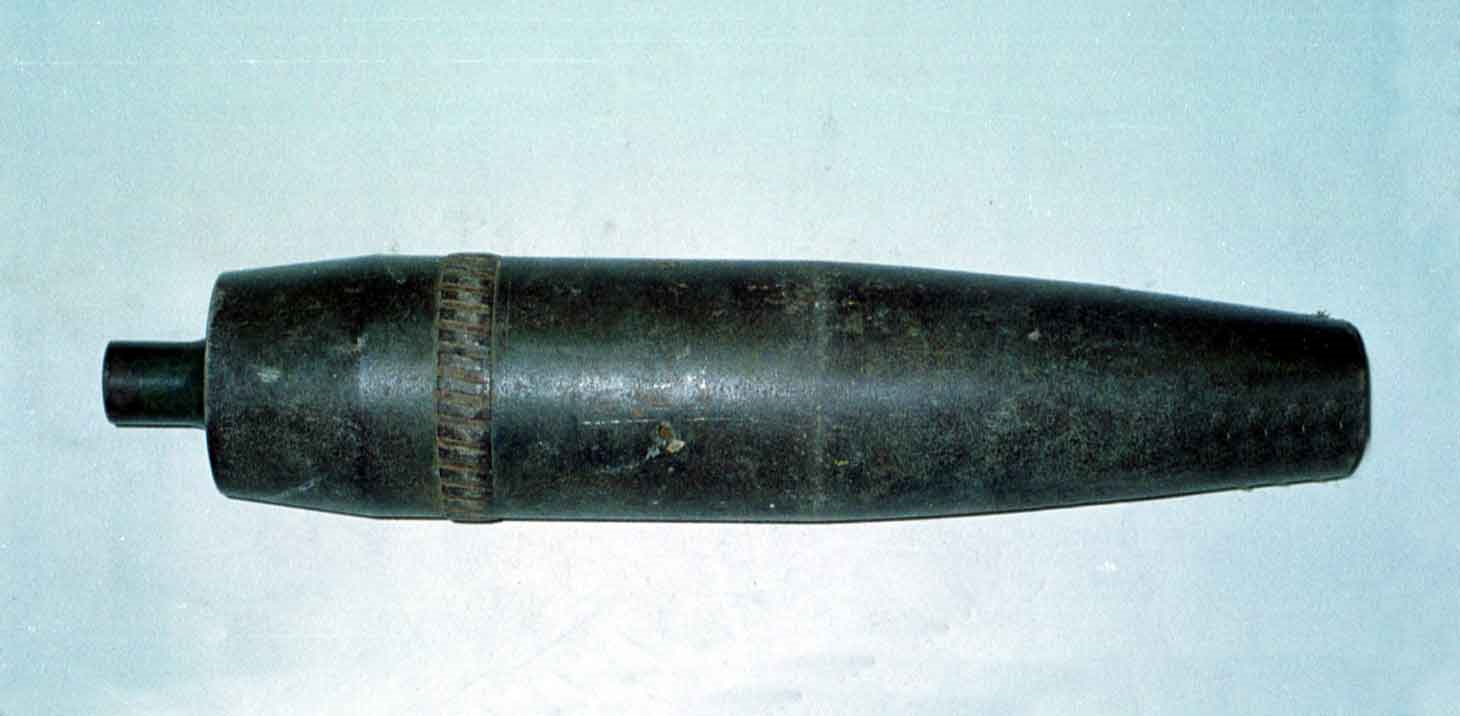
This cartridge is a high explosive, rocket assisted round with extended range capability used for fragmentation, blast and mining in support of ground troops and armored columns.
The projectile consists of two pieces, a streamlined warhead and rocket motor body of boattail design. The nose of the warhead is threaded for a fuze and the warhead is filled with cast Composition B having a deep cavity and supplementary charge. The rocket motor body contains the rocket grain and rocket ignition system, contained in a spike at the rear of the body. The spike housing ignition system is fitted with a cap. A sintered iron rotating band is swaged to the rocket motor body and the body threaded to the warhead to complete the projectile assembly The cartridge case contains a primer and five individually bagged and numbered propelling charge increments. The base of the cartridge case is drilled and a percussion primer assembly is pressed into the base. The percussion primer assembly consists of a percussion ignition element and a perforated flash tube containing benite. The five numbered increment bags are tied together, in numerical order, 3, 4, 5, 6 and 7 with acrylic cord. These are assembled into the cartridge case, around the primer flash tube, with Increment 3 at the base of the cartridge case and Increment 7 toward the mouth of the cartridge case.
The projectile is olive drab with yellow markings.
Functioning
Rocket “OFF-MODE” - If the projectile is unfuzed, the closing plug is removed and a fuze assembled to the projectile, and if required, is set. The cartridge is loaded into the weapon. Upon firing, impact of the weapon firing pin results in the initiation of the percussion primer which, in turn, ignites the benite in the flash tube. The flash tube provides for uniform ignition of the propelling charge producing a rapid expansion of the propellant gas which propels the projectile out of the weapon tube. Engagement of the projectile rotating band with the rifling of the weapon tube imparts spin to the projectile providing in-flight stability. Projectile functioning is dependent upon the fuze used and may function on impact (instantaneous or delay), function above ground either at a predetermined height based upon time of flight, or function in proximity with target area. Fuze function detonates the HE projectile filler resulting in projectile fragmentation and blast.
Rocket “ON-MODE” - The fuse is assembled to the projectile as in the Rocket “OFF-MODE”. The rocket cap, on the spike of the projectile, is removed and the cartridge case with propellant is slipped over the projectile and the cartridge loaded into the weapon. After firing, the burning propellant gases initiate the ignition composition which, in turn, ignites the delay composition. Approximately 16 seconds later (the projectile has left the tube and is traveling down-range), the balance of the rocket motor ignition system ignites the rocket motor. The rocket motor burns for 2 seconds boosting the projectile velocity resulting in a greater projectile range. Fuze initiation, as described for Rocket “OFF-MODE”, detonates the projectile HE filler resulting in projectile fragmentation and blast.
Hazardous Components
Filler - Composition B (5.2 lb, 2.36 kg)
Cartridge case - M14, M14B1, M14B4
Propelling charge - M176 (2,84 lb, 1.29 kg)
Primer assembly - M108
Benite - 210 grains
Rocket propellant - XM33, nitrocellulose based (1.06 lb, 0.48 kg)
Physical Data
Length, overall - 32.7 in, 830.6 mm
See Also
Source(s)
TM 9-1300-203, Artillery Ammunition (1967)
