Description
The bombs BLU-4/B and BLU-4A/B are air delivered, drag-vane stabilized, impact ejected, lanyard fired, high explosive, antipersonnel fragmentation bombs.
The bomb BLU-4/B is used with the SUU-7/A dispenser. This combination is designated CBU-1/A.
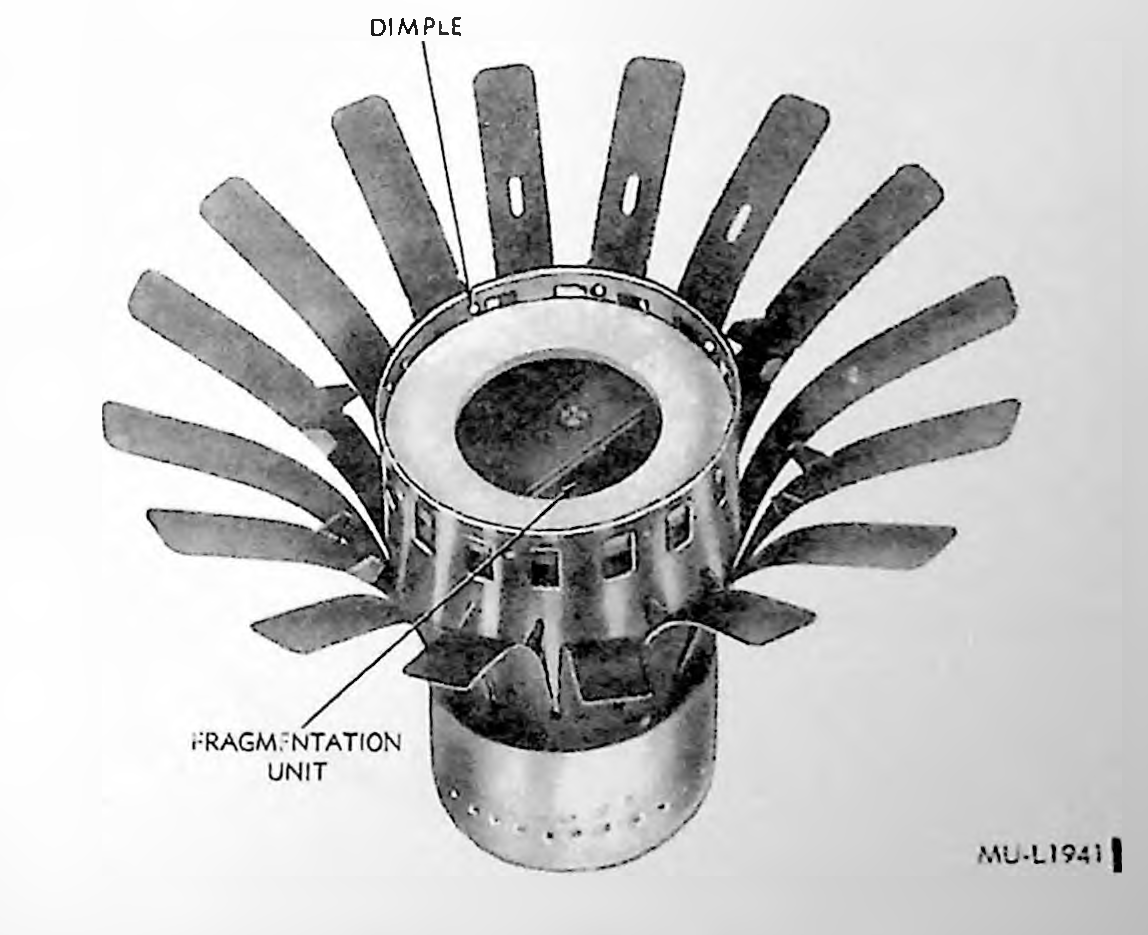
Each of these bombs consist of a bomb shell, an ejection cup assembly (with fuze), a fragmentation unit (with fuze), and a lanyard.
The bomb shell consists of the bomb shell body and a 16-drag-vane stabilizer. The drag vanes are held in the closed position by a 1/2 inch wide metal retaining band. The band in turn is secured by a metal wind tab. The bottom of these bombs contain a 1/4 inch machine screw which is inserted just prior to the time the bomb is placed in the dispenser.
The ejection cup consists of an impact ejection fuze (with a conical spring), and a sabot, housed within the metal ejection cup. The ejection cup contains an ejection charge. The ejection cup assembly is located at the base of the bomb shell. A spring-loaded primer cam is held in the out-of-line position by the firing pin which fits into a hole in the cam.
The fragmentation unit is hemispherical in shape and is located in the upper portion of the bomb shell, above the ejection cup assembly. A fuzing device, containing a spring-loaded detonator slide, is held in the safe position by a spring-loaded locking pin. The locking pin is held in the “in” position by a yoke which has one end locked under the hat assembly, the other end is fitted into a groove on the base of the fuzing device.
The lanyard which is 10 feet long, has one end attached to a bail on the hat assembly. The opposite end is secured to the bomb shell under the ejection detonator rotor.
The bomb shell body, wind tab, retaining band, and fragmentation unit body are steel. The sabot is made of phenolic and steel (steel firing pin embedded in plastic). The fragmentation unit fuzing assembly is aluminum. The lanyard is nylon.
The bomb shell is brass colored. The drag vanes are painted olive drab. The sabot (adapter-striker) is colored black, with a steel colored steel firing pin. The fragmentation unit is colored silver.
The markings are either black or yellow.
Functioning
When the bomb is dispensed, the air stream strips the wind tab from the drag vane retaining band. The retaining band falls free, allowing the drag vanes to open. Opening of the drag vanes allows the conical spring (on the impact ejection fuze) to force the sabot and the fragmentation unit slightly upward, removing the firing pin from the hole in the cam which incorporates the primer. This action allows the rotor to rotate to the in-line position, arming the ejection cup assembly.
Upon impact, the firing pin is driven into the primer of the delay assembly located above the ejection charge, igniting the ejection charge. Gas pressure from the ejection charge drives the fragmentation unit and the sabot into the air. The fragmentation unit is arrested in flight by the lanyard. The tension on the lanyard causes the bail on the fragmentation unit to move down and out, thereby allowing the yoke to be ejected. Removal of the yoke from beneath the yoke releases spring permits the release pin of the fragmentation unit fuze to disengage itself from the slide, thereby permitting the spring loaded detonator slide to move. The movable detonator slide is forced into the fixed firing pin of the explosive fuze assembly, firing the M55 stab detonator which initiates the explosive train and detonates the fragmentation unit.
Hazardous Components
The BLU-4/B contains approximately 2.82 ounces (approximately 81 grams) of RDX.
Physical Data
Length, overall - 4.92 in, 124.9 mm
Diameter - 2.76 in, 70.1 mm
Width, deployed vanes - 6.75 in, 171.5 mm
See Also
Source(s)
TM 9-1385-51, Ammunition (Conventional) for Explosive Ordnance Disposal (1967)
