Description
The E139 was designed to provide long range offensive chemical capabilities.
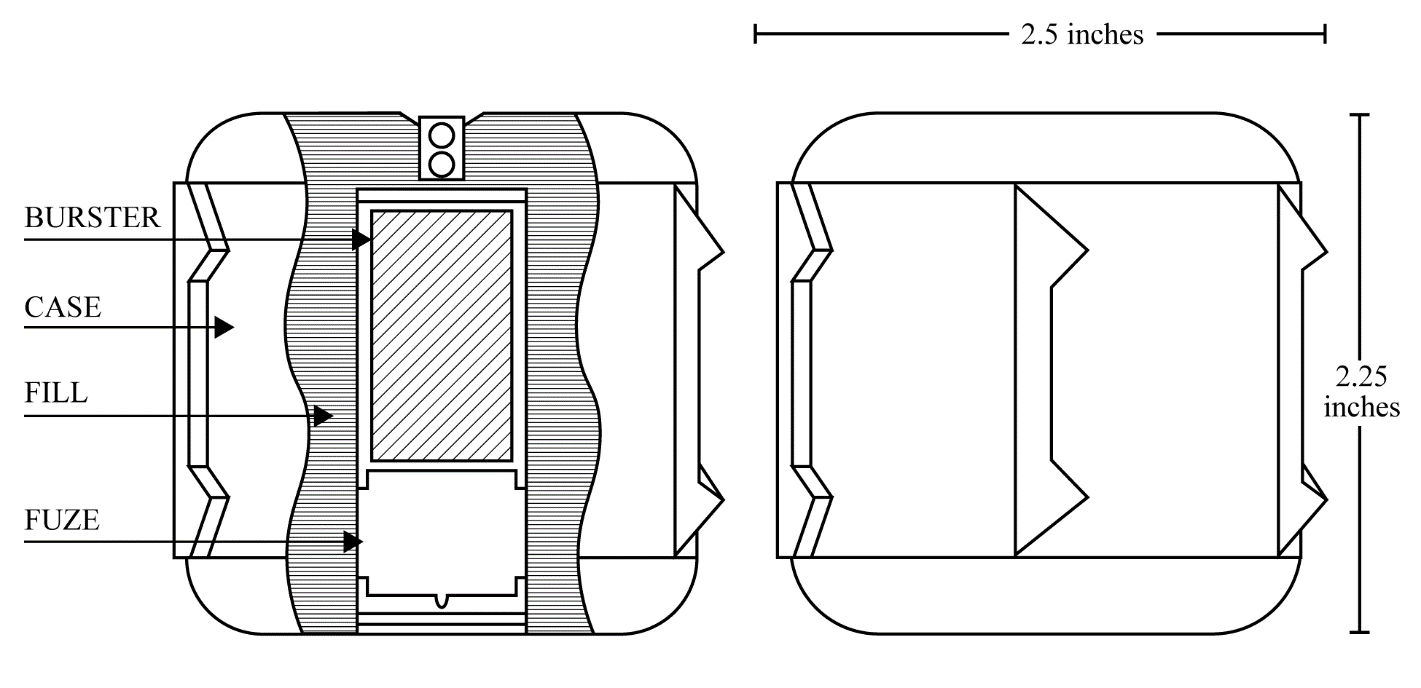
The E139 bomblet was a self-dispersing cylindrical munition. It was constructed of two cylindrical cups, each made of approximately 0.045-inch thick aluminum alloy. These cups were TIG welded together at their periphery. A 0.137-pound hard lead band was wrapped in a groove around the body midsection for rotational inertia effects. One end of the bomblet contained a filling opening that was sealed after filling by a pressed double-ball closure. The opposite end had an accessible burster well. The burster assembly consisted of a tetryl pellet (encased in polyethylene) that was 0.98-inch in diameter and 0.671-inch long, the M219E1 grenade fuze, and a steel compression spring, washer, and snap-ring retainer. A collar of 0.020-inch thick aluminum alloy, which had been extruded with six integral driving ribs, was pressed onto the cylindrical body. In flight these ribs induced the bomblet to spin about its longitudinal axis to arm the M219E1 fuze, as well as to create an aerodynamic lifting force on the bomblet for dispersion
Functioning
The armed fuze functioned upon impact with the ground when a stab type firing pin initiated the detonator, thereby igniting a lead cup of Royal Demolition Explosive (RDX) which would disseminate the agent.
See Also
Impact, M219, M219A1, M219A2
Source(s)
Old Chemical Weapons and Related Materiel Reference Guide (2018)
