Description
Gray over all with a green tipped nose and a brown nose band.
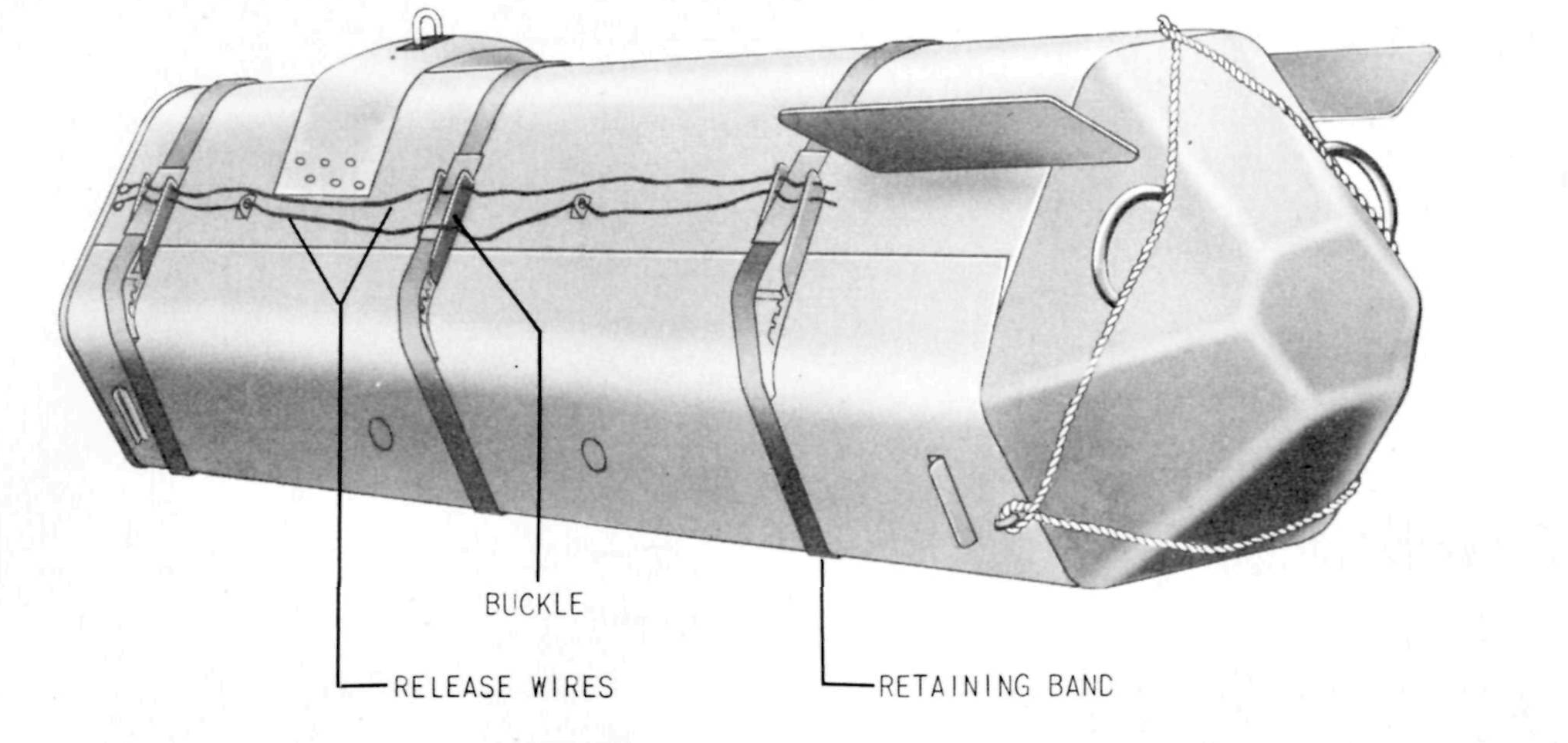
The hexagonally shaped bomb container consists of a blunt-nose assembly and a light tail piece around which are fitted three sheet steel sections held together by three metal retaining bands. Two steel wires run longitudinally along the exterior of the container and pass through the three retaining band buckles. One wire is attached to the nose piece; the other is a safety wire which is removed after the container has been placed in the bomb rack.
The nose section is of two-piece construction. The after piece is attached to the sheet steel sides by a welded stud for each section. The forward piece is attached to the after one by three lead sealing strips. The nose piece, which has a fuze pocket to take the D-4 (a) is filled by a wooden block. A round metal can containing the burster charge in an annular silk bag is set off-center in the wooden block. The initiating charge in the burster is directly beneath the fuze magazine. The balance of the charge is off-center toward the point where the retaining band release wire is secured to the nose piece. The purpose of this offset is to exert a more direct pull on the release wire when the charge is detonated.
The tailpiece is held in place by a bungee cord fastened to a hook on the after end of each body section.
Two tail fins are riveted to the after portion of the sheet steel section to which the suspension lug is attached.
Two metal plates divide the container into three sections in each of which are packed 12 1-kilogram bombs.
Hazardous Components
36 1 kg high explosive bombs. Total filler weight is 80 lbs, 36.4 kg.
See Also
General Information, Japanese Navy Bombs
Nose, D-4(a), for Parachute Flare Type 0 Model 1
Source(s)
