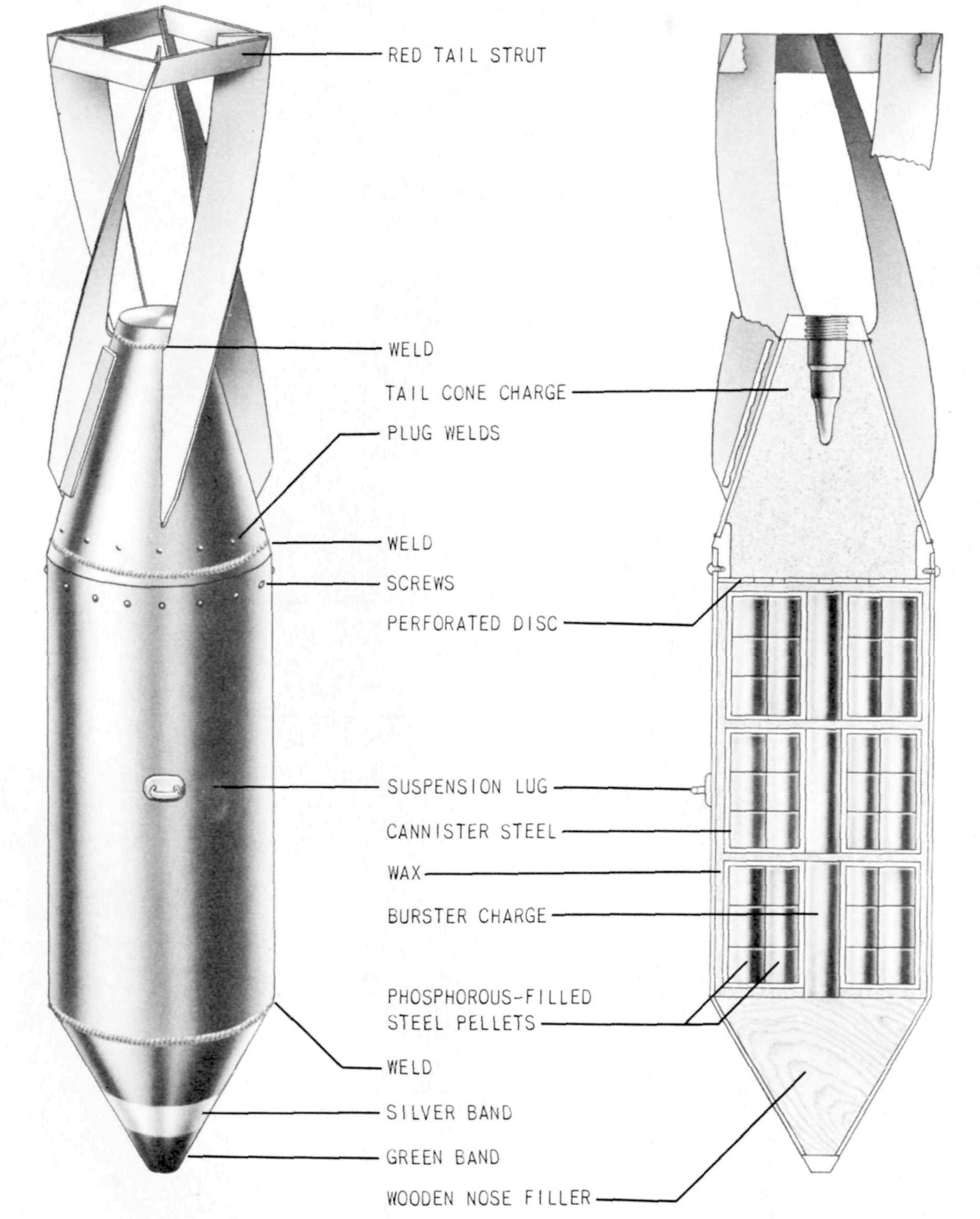
Description
Silver nose tipped with a green band. Body is gray overall, except for red tail struts. Marked "Provisional designation type 3 No. 6 Mk 3 Model 1."
The bomb consists of a nose piece, body and tail assembly. The conical shaped nose piece is welded to the body and has a steel plate welded where the fuze pocket would be. The cavity in the nose piece is filled with a wooden block. The body is cylindrical in shape and is welded longitudinally. The tail cone is welded to a coupling ring which fits into the body and is held there by a single row of screws. A burster charge of cast type 98 explosive is contained in the tail cone. A perforated steel plate separates the explosive from the incendiary filling.
The tail cone is welded longitudinally. Four angled fins are welded to the cone and braced by a single set of box-type struts. The angle of these fins imparts a counterclockwise rotation in flight to the bomb, thereby arming the clockwork fuze.
Hazardous Components
Three cylindrical steel canisters each containing 87 white phosphorus filled cylindrical steel pellets. Each canister has a central exploder tube filled with Type 98 explosive. A heavy wax coating covers each canister.
3 canisters - 72 lbs, 32.7 kg; tail cone charge, 11.2 lbs, 5.1 kg.
See Also
General Information, Japanese Navy Bombs
Tail, D-2(b), Aerial Burst
Tail, D-2(c), Aerial Burst
Source(s)
