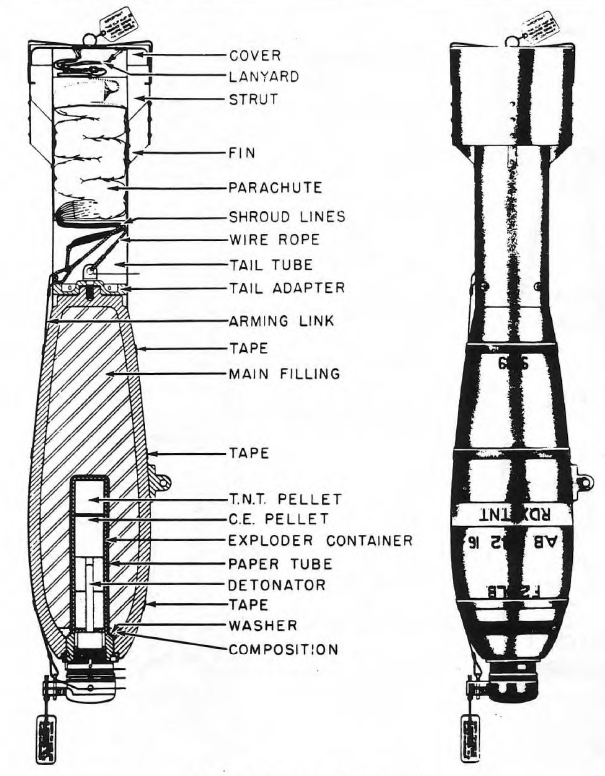
Description
This bomb has a streamlined, one-piece, cast-steel body, with the nose end open to take an exploder container. The rear end is reduced to form a spigot for taking the tail adapter. The boss on the spigot is tapped and threaded to receive the tail adapter securing bolt. The exploder container is cemented in position and locked by a locking screw.
The parachute tail unit consists of a tail tube with a cylindrical strut connected to its rear portion by four fins. The parachute, which is housed in a fabric cylinder, is contained in tail tube. A loose-fitting metal cover in the after end of the tube is attached to the fabric cylinder. The parachute cords are connected to a wire rope secured to an eyebolt which connects the tail adapter and the body. The tail adapter is secured in the front end of the tail tube by four screws. When dropped, the metal end cover in the tube is blown off by the air slip, and acts as a pilot parachute to pull the main parachute out of the tube.
The Small Bomb Container, 160 lb, contains eight of these bombs. The Small Bomb Container, 250 lb, contains 12 of these bombs. These bombs are no longer being manufactured. However, they may be encountered in the field. They are being replaced by the 8 lb fragmentation bombs.
Functioning
No information about functioning.
See Also
British Bombs - Designation and Classification
Small Bomb Container, 160 lb
Small Bomb Container, 250 lb
Source(s)
OP 1665, British Explosive Ordnance (1946)
