Description
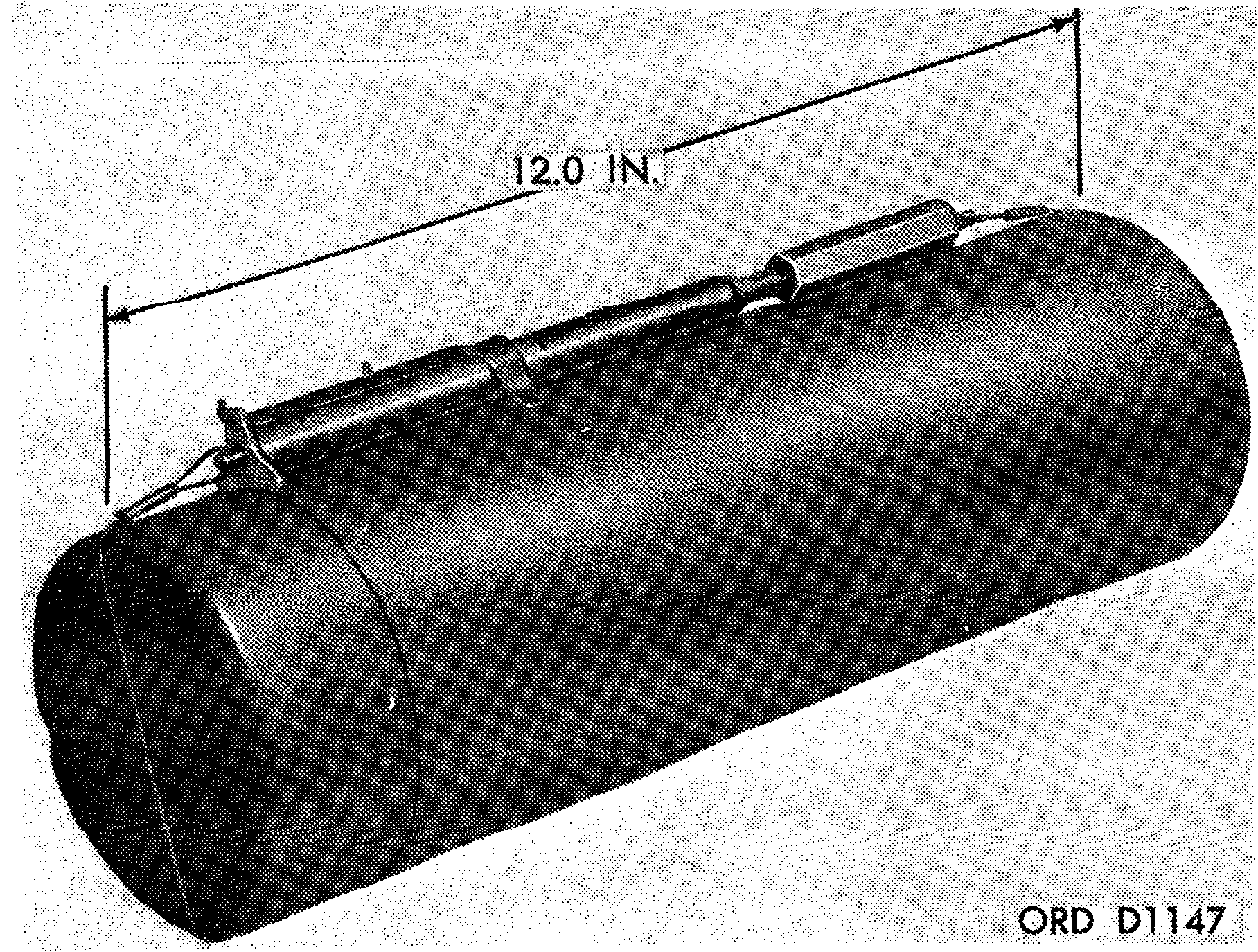
The body of gas bomb M125A1 is a sheet- steel cylinder with a burster well and fuze at the front end and a parachute at the rear.
Gas bomb M125 is identical with the M125A1 except that the M125 uses the parachute-opening delay M1 instead of the M1A1. Delay M1 differs from the M1A1 in that a spring loaded lockpin, which is restrained by the arming bar, holds the firing pin in the delay instead of a detent. The M125 bomb is used in M34 nonpersistent gas bomb clusters.
Functioning
Bombs are arranged in the cluster so that the arming bars on all parachute-opening delays are depressed by contact with other bombs in the cluster.
When the bomb is released from the cluster, the arming bar springs away from the parachute opening delay, and the firing pin in the delay fires the primer. The primer ignites the delay charge which burns for 3 to 7 seconds, then sets off the explosive charge in the parachute opening delay. The explosion breaks the stranded steel cable, freeing the tail cup and removing restraint from the fuze arming ring. The parachute opens and abruptly slows the descent of the bomb. The rapid deceleration causes the arming ring to fall from the fuze, thus arming the fuze.
When the bomb impacts, the fuze initiates the burster which ruptures the body and releases the bomb filler.
Hazardous Components
The filler consists of 2.6 pounds of GB.
Parachute opening delay M1A1 is fastened to the outside of the bomb. The delay is a metal tube 1/2 inch in diameter and 6 1/4 inches long containing a firing mechanism, a delay charge, and an explosive charge. The delay is held on the bomb by a stranded steel cable which is wrapped around the long axis of the bomb and fastened at each end of the delay. A detent, which is part of an external arming bar, restrains a firing pin in the delay while the bomb is clustered.
A burster M31 is installed in the burster well.
A bomb fuze M196 is installed in the nose section at the time of manufacture.
See Also
Cluster, 1000 lb Chemical, M34 (E101R3), M34A1 (E101R5)
Source(s)
Old Chemical Weapons and Related Materiel Reference Guide (2018)
Old Chemical Weapons Reference Guide (1998)
TM 9-1325-200, Bombs and Bomb Components (1966)
TM 3-400, Chemical Bombs and Clusters (1957)
