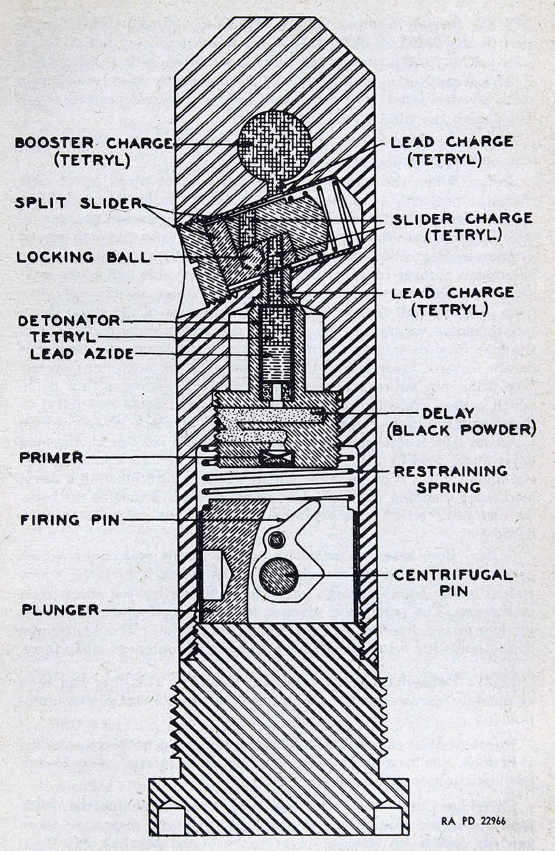
Description
This fuze is used in the Shell, HE, M1915, in which nondelay action is required. The fuze, however, can be manufactured with a short delay of 0.05 second or a long delay of 0.15 second by merely adding a black powder pellet. It is a boresafe fuze, and loaded projectiles are issued with the fuze assembled in place.
The BD, Mk V, Major Caliber Fuze is exactly the same as the BD Mk V Medium Caliber Fuze, except for the size of the head or base that assembles to the lower part of the fuze body. A larger head is required' for screwing into the base plug of the 14-inch high-explosive shell.
Functioning
When the gun is fired, no action takes place in the fuze while the projectile is in the weapon. After the projectile has left the muzzle of the gun, the centrifugal pins in the percussion plunger recede and the eccentrically weighted firing pin is swung into armed position by centrifugal force. Simultaneously with this arming of the percussion plunger by centrifugal force, the movable half of the split slider is forced outward against its spring, lining up the explosive train. A metal ball located in the stationary part of the slider drops into the space vacated by the movable part of the slider and prevents the fuze from disarming. On impact, the armed percussion plunger is driven forward, overcoming the resistance of the restraining spring. The firing pin strikes the percussion primer, creating a tiny flame which causes explosion of the detonator of lead azide and tetryl in the nondelay fuze, or ignites a delay train of black powder which burns for 0.05 second for the short delay, or 0.15 seconds for the long delay fuze. This in turn sets off a tetryl lead charge leading to the slider, and tetryl charges in the slider, which in turn function a tetryl lead charge leading from the slider. This, in turn, detonates the booster charge of tetryl. The explosive charge of the projectile is then detonated.
Bore safety is achieved by use of the split slider which prevents any action of the primer or detonator from being transmitted to the booster charge until the projectile has left the muzzle of the gun. The percussion plunger, also a safety feature, arms at a predetermined number of revolutions per minute. The restraining spring holds the firing pin off the primer and counteracts creep force.
See Also
Source(s)
TM 9-1904, Ammunition Inspection Guide (1944)
